







Stronger Hands Better Health: When people think about building strength, they often focus on big, visible muscle groups such as the biceps, chest, glutes, or legs. Grip strength, by comparison, tends to be overlooked. Yet experts increasingly agree that grip strength is one of the most important—and revealing—indicators of overall physical health and functional fitness.
Grip strength refers to how firmly and securely you can hold onto objects and how much weight or resistance your hands can manage. From opening jars and carrying groceries to lifting weights and improving athletic performance, grip strength plays a crucial role in everyday life. Research also shows that it is closely linked to muscle endurance, mobility, and even brain health.
Here’s a comprehensive, science-backed look at why grip strength matters, how to measure it, and the most effective exercises to improve it.
What Is Grip Strength and Why Does It Matter?
Grip strength is not a single ability. Instead, it consists of three distinct types, each of which plays a different role in daily tasks and physical performance:
- Crush grip: The force generated when you squeeze something between your fingers and palm, such as a dumbbell or stress ball.
- Support grip: The ability to hold onto an object or support your body weight for a period of time, such as hanging from a pull-up bar or carrying heavy bags.
- Pinch grip: The strength used when pinching an object between your fingers and thumb, like holding a weight plate or opening a tight lid.
Improving all three types of grip strength leads to stronger, more capable hands and forearms, and supports overall strength development throughout the body.
The Best Exercises to Improve Grip Strength
Experts recommend targeting all three grip types for balanced improvement. The following exercises are simple, effective, and backed by practical experience in strength training and rehabilitation.
1. Towel Wring
- Type of grip: Crush
- Equipment needed: A towel and water
How to do it:
Wet a towel thoroughly and hold one end in each hand so it is stretched horizontally in front of you. Twist your hands in opposite directions to wring out the water. Continue twisting until no more water comes out. Re-soak the towel and repeat, twisting in the opposite direction to ensure both hands work equally. Perform at least three full rounds.
Why it works:
The towel wring mimics real-world gripping tasks and builds endurance and crushing strength in the fingers and palms.
2. Hand Clench (Ball Squeeze)
Type of grip: Crush
- Equipment needed: Stress ball, tennis ball, or grip trainer
How to do it:
Place the ball in the palm of your hand and squeeze it using your fingers (avoid using the thumb). Squeeze as hard as possible, then release. Repeat 50 to 100 times per day for noticeable improvements.
Why it works:
This simple movement directly strengthens the finger flexor muscles responsible for strong grips and is ideal for beginners or those recovering from injury.
3. Dead Hang
- Type of grip: Support
- Equipment needed: Pull-up bar or sturdy horizontal bar
How to do it:
Grip the bar with your palms facing forward and fingers wrapped over the top. Lift your feet off the ground and hang with your arms fully extended. Hold for as long as possible, starting with 10 seconds and gradually increasing to 60 seconds. For an added challenge, bend your arms to a 90-degree angle and hold for up to two minutes once you are more advanced.
Why it works:
Dead hangs build exceptional support grip strength while also improving shoulder stability and posture.
4. Farmer’s Carry
- Type of grip: Support
- Equipment needed: Dumbbells (typically 20–50 pounds, depending on strength level)
How to do it:
Hold a dumbbell in each hand at your sides with palms facing inward. Keep your chest up and posture tall. Walk forward for 50 to 100 feet, turn around, and walk back. Repeat three times.
Why it works:
Farmer’s carries closely replicate real-life lifting and carrying tasks and are among the most effective grip and total-body strength exercises.
5. Pinch Grip Transfer
- Type of grip: Pinch
- Equipment needed: Two weight plates (at least 10 pounds each)
How to do it:
Stand upright and pinch the edge of a weight plate with your fingers and thumb. Raise it in front of your chest, then transfer it to your other hand using the same pinch grip. Lower the plate to your side, lift it again, and transfer it back. Perform 10 transfers, three times per day.
Why it works:
This exercise directly strengthens thumb and finger coordination, which is essential for fine motor control and functional hand strength.
Also Read: Calories Decoded: The Surprisingly Simple Math Behind Losing Weight Without Starving Yourself
6. Plate Pinch Hold
- Type of grip: Pinch
- Equipment needed: Two weight plates and a raised surface
How to do it:
Place two weight plates flat on the ground. Grab them together using your fingers on one side and thumb on the other. Lift them, stand upright, and hold for five seconds. Set them down on a raised surface, pause, and repeat 5–10 times.
Why it works:
Plate pinches challenge the smaller stabilizing muscles in the hands, improving grip endurance and control.
How to Measure Grip Strength
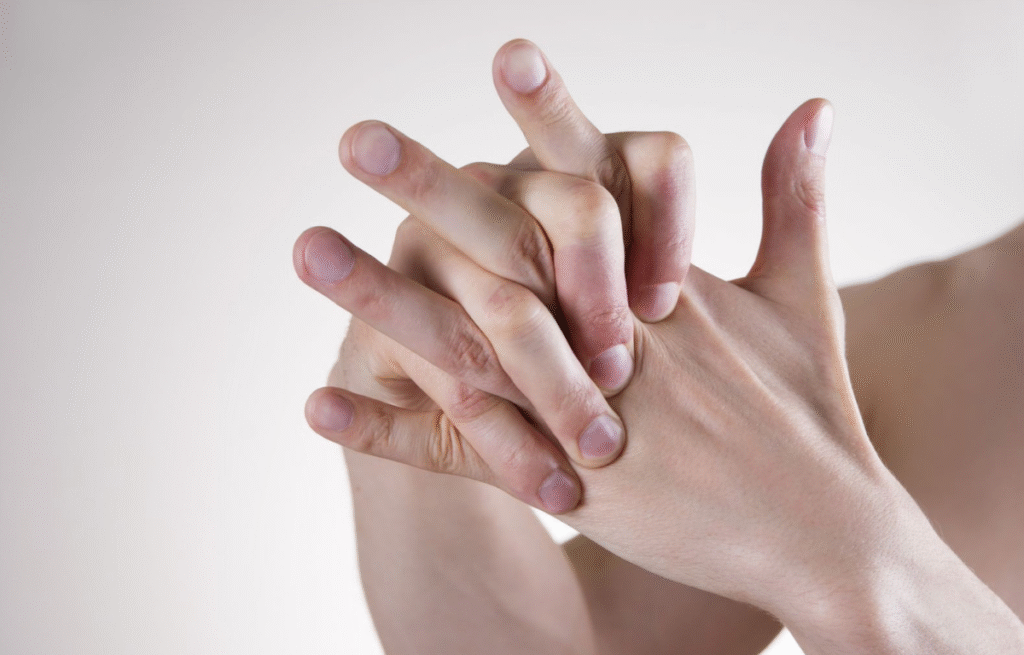
Tracking grip strength can help you monitor progress and identify imbalances between your hands. Two commonly accepted methods are used:
- Handgrip dynamometer:
Hold the device with your elbow bent at a 90-degree angle and squeeze as hard as possible. This is the gold standard used in research and clinical settings. - Weight scale method:
Place the heel of your hand on top of a bathroom scale and grip the bottom with your fingers. Push down as hard as you can and note the reading.
It is recommended to measure both hands, as differences between dominant and non-dominant hands are common.
Average Grip Strength for Men and Women
A large Australian population-based study conducted in 2011 reported the following average grip strength values:
| Age Group | Men (Left | Right) | Women (Left | Right) |
|———|————|————-|
| 20–29 | 99 lbs | 103 lbs | 61 lbs | 66 lbs |
| 30–39 | 103 lbs | 103 lbs | 63 lbs | 68 lbs |
| 40–49 | 99 lbs | 103 lbs | 61 lbs | 63 lbs |
| 50–59 | 94 lbs | 99 lbs | 57 lbs | 61 lbs |
| 60–69 | 83 lbs | 88 lbs | 50 lbs | 52 lbs |
Grip strength naturally declines with age, but regular training can slow this decline significantly.
Also Read: नई Mitsubishi Eclipse Cross: Renault Scenic के रीबैज्ड इलेक्ट्रिक क्रॉसओवर का अनावरण
Factors That Can Affect Grip Strength Readings
Your grip strength may vary depending on several factors, including:
- Energy levels and fatigue
- Hand use earlier in the day
- Overall health or illness
- Underlying medical conditions affecting nerves or muscles
For accurate tracking, try to measure grip strength at the same time of day under similar conditions.
Why Grip Strength Is So Important
Grip strength plays a role in a wide range of daily activities and sports, including:
- Carrying grocery bags or luggage
- Lifting children or heavy objects
- Performing household chores like shoveling or gardening
- Rock climbing and obstacle course activities
- Sports such as tennis, golf, baseball, hockey, and martial arts
- Weightlifting and CrossFit exercises
Beyond physical tasks, grip strength is increasingly recognised as a key health marker. A landmark 2011 study found that grip strength strongly predicts overall muscle strength and endurance. More recently, a 2018 study reported that grip strength is an accurate predictor of cognitive function, both in the general population and among individuals diagnosed with schizophrenia.
These findings suggest that grip strength reflects not just muscular fitness, but also neurological and metabolic health.
Stronger Hands Better Health Conclusion
Grip strength is far more than a measure of how hard you can squeeze. It is a powerful indicator of overall strength, functional ability, and long-term health. From daily chores to athletic performance and even cognitive well-being, strong hands support a strong body and mind.
By incorporating simple, targeted exercises such as towel wrings, dead hangs, farmer’s carries, and pinch holds into your routine, you can significantly improve your grip strength over time. Consistency matters more than intensity, and even a few minutes a day can yield meaningful results.
In a fitness world often obsessed with big muscles, grip strength stands out as a small detail with a big impact—one that deserves a firm hold on your training priorities.